[et_pb_section fb_built=”1″ admin_label=”section” _builder_version=”4.16″ global_colors_info=”{}” theme_builder_area=”post_content”][et_pb_row _builder_version=”4.27.3″ _module_preset=”default” global_colors_info=”{}” theme_builder_area=”post_content”][et_pb_column type=”4_4″ _builder_version=”4.27.3″ _module_preset=”default” global_colors_info=”{}” theme_builder_area=”post_content”][et_pb_text _builder_version=”4.27.4″ _module_preset=”default” hover_enabled=”0″ global_colors_info=”{}” theme_builder_area=”post_content” sticky_enabled=”0″]
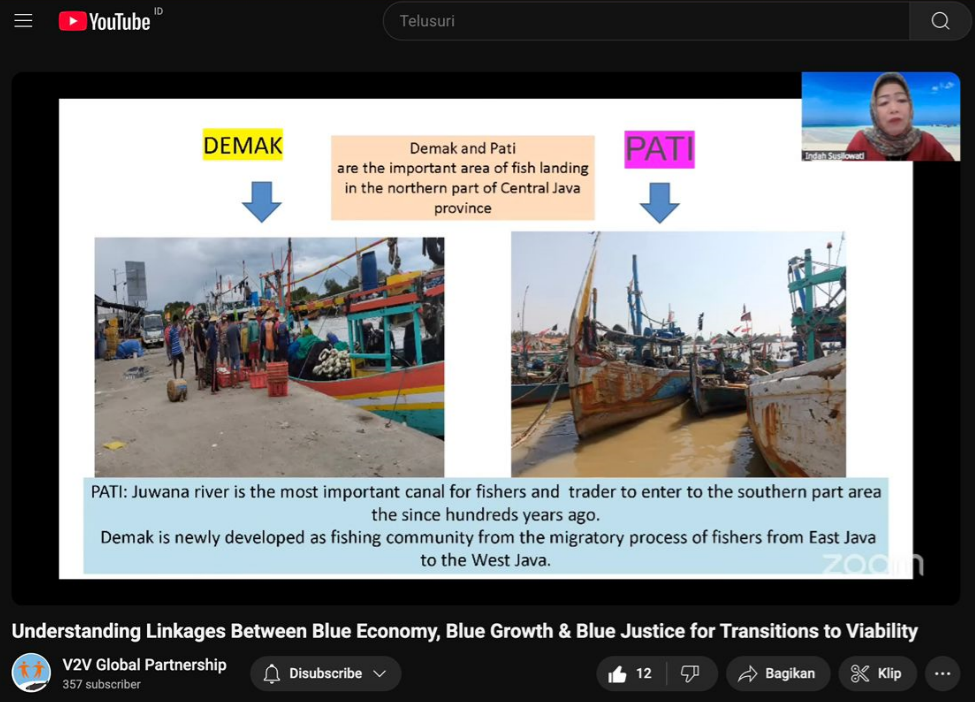
Semarang – In an effort to address the challenges of social inequality and environmental sustainability in coastal areas, UNDIP Professor of Economics, Professor Indah Susilowati emphasized the importance of the transition from blue growth to blue justice in a scientific presentation prepared together with other authors Hapsari Ayu Kusumawardhani, Aini Nur Furoida and Ika Suciati.
Prof. Indah in her presentation stated that ecologically efficient economic growth is not enough if it is not accompanied by fair distribution, inclusive processes, and recognition of the diversity of identities and roles of local communities. Blue justice positions coastal communities not as objects of development, but as active subjects who have a voice and interests in the process.
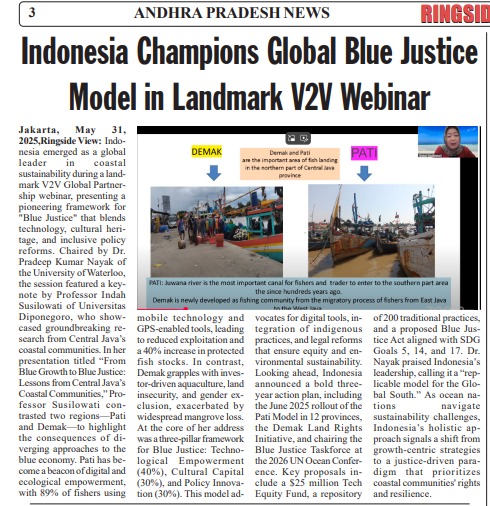
Through the results of collaborative research between senior academics and young researchers in the coastal-marine fisheries areas of Demak and Pati, Central Java, a number of indicators were compiled to measure how coastal communities transition from vulnerable conditions to social, economic and ecological sustainability. The study systematically maps blue economy activities in both regions, which forms the basis for understanding how economic growth can go hand in hand with the principles of social justice. This presentation provides new insights into how the synergy between growth and justice can be realized as a mutually reinforcing process.
Professor Indah Susilowati, who also serves as the National Coordinator of the V2V (Vulnerability to Viability) program, has expertise in the fields of resource and environmental economics, as well as coastal resource management. She has been actively assisting government policies through her role as an expert for the Ministry of Research, Technology, and Higher Education since 2005, and has been a consultant on sustainability issues in various regions. Her involvement in the Asian Fisheries Society (AFS) and the International Institute of Fisheries Economics and Trade (IIFET), including as a member of the AFS Board for the 2025–2028 period, confirms her international footprint. In addition, through her involvement in the Gender in Aquaculture and Fisheries (GAF) initiative, she has also consistently promoted student participation and gender equality in coastal area development.
[/et_pb_text][/et_pb_column][/et_pb_row][/et_pb_section]